Open Field or Winding Courtyard? Two Festival Spaces Compared
Compare open-field and winding-courtyard festival spaces to see how each layout guides orientation, encounters and the mood of moving between events.
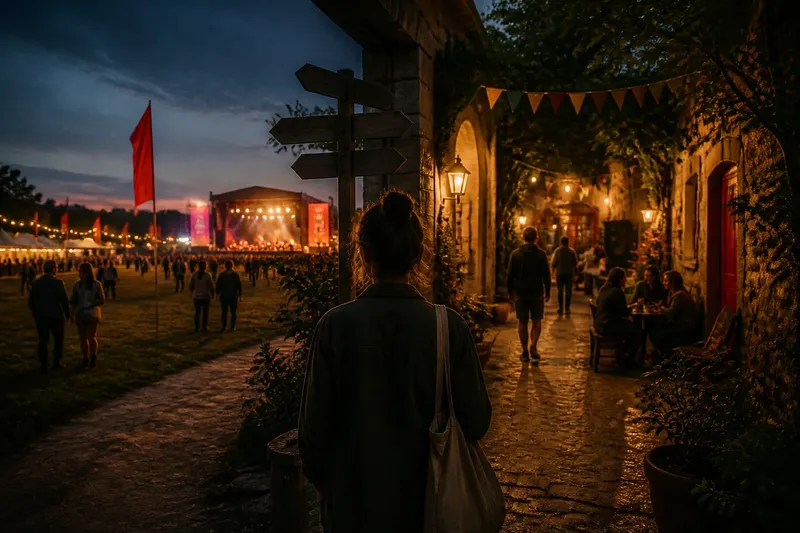
Which festival space makes it easier to find your next event without losing the pleasure of the journey? Open-field festival spaces and winding-courtyard layouts answer that question differently: one offers broad sightlines and visible landmarks, while the other reveals its routes and gathering places in stages.
Neither shape is automatically easier or more sociable. The useful comparison is how each handles three moments: arriving, choosing where to go and crossing paths with other people. Follow those moments during a visit and the site becomes legible without turning every walk into a navigation task.
Open-field festival spaces make destinations visible
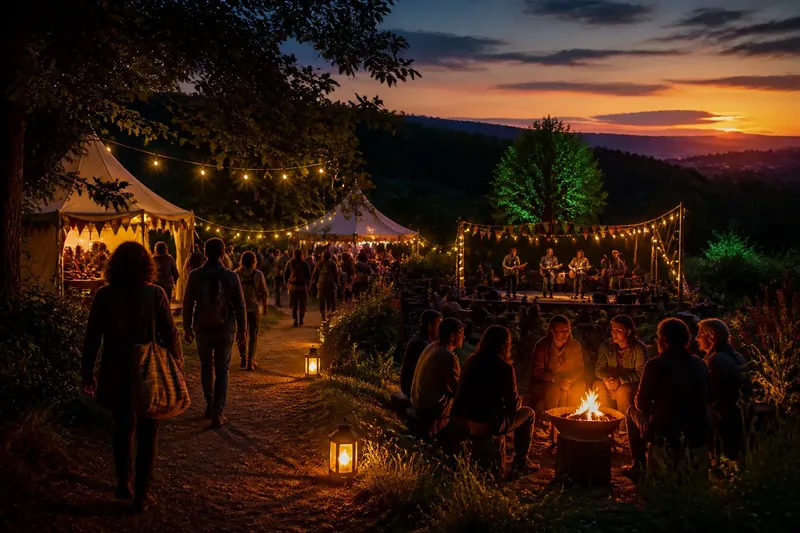
On an open field, a stage, food stall or meeting point may be visible from a distance. That sightline helps visitors orient themselves quickly: a bright banner beside the main stage can act like a familiar object across a large room. The trade-off is that distant destinations can look deceptively close, while several routes may converge across the same exposed ground.
Look for features that break the field into recognisable areas. A row of trees, a change in ground surface, a sculpture or a distinct cluster of seating can give each part a name in your mind. If every area looks alike, a landmark that stands above the crowd will usually be more useful than a sign placed at ground level.
Open layouts also make movement feel collective. You can see a crowd drifting towards a performance, notice a quieter edge and decide whether to join the flow or pause. Encounters are often brief and visible; people can spot one another across a distance, but there may be fewer sheltered nooks for a conversation to linger.
Winding courtyards turn movement into discovery
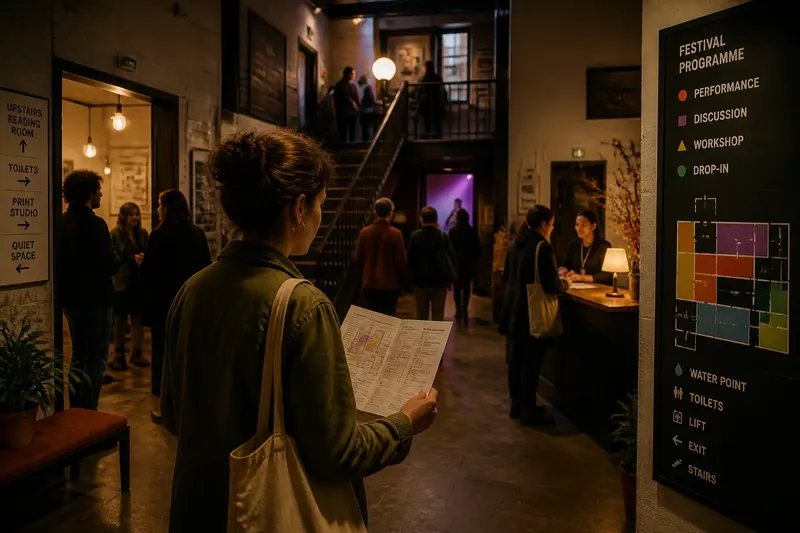
A courtyard layout depends on partial views. A passage may open into a small stage, a shaded seating pocket or a stall-lined square; each threshold gives a fresh sense of arrival. This can make short distances feel eventful, because the next gathering place is not always visible from the one you have just left.
The same enclosure can make orientation less immediate. Visitors may pass through similar-looking arches or turn into lanes that resemble one another. Distinctive details help: a painted doorway, a fountain, a tall sign or a change from stone paving to timber decking can serve as a mental marker. Repeated signs at decision points matter more than one elaborate map at the entrance.
Courtyards can create intimate encounters because people meet at corners, doorways and shared edges. A small performance may feel close to the surrounding stalls, while a quiet seating space can offer a pause from the main route. Yet narrow passages may become uncomfortable if a crowd gathers where people also need to pass, so notice whether the site lets visitors stop without blocking the way.
Use a simple route routine to learn the site
If you are attending a multi-day festival, a light routine can reveal how its layout works at different times. The aim is not to plan every performance, but to learn the site and choose routes that suit your energy and interests.
- Before your first visit: Check the map for entrances, stages, toilets, food areas and marked accessible routes. If the map names a clear meeting point, use it; if not, choose a distinctive landmark and agree on its exact location with your group.
- On arrival: Identify the nearest entrance sign and the first landmark you can recognise from it. If the landmark is easy to see along the route, use it to orient yourself; if it disappears behind buildings or crowds, rely on the map at the next junction.
- On the first walk to an event: Notice where the route bends, what surfaces change and which signs appear at decision points. If the route remains clear, remember its sequence; if it becomes ambiguous, check the map before continuing rather than guessing.
- On the way back: Compare the direct route with an alternative path, if one is open. If the alternative passes useful seating or quieter edges, keep it in mind for a slower return; if it adds confusing turns, use the clearer route instead.
- At a busy area: Look for queues, temporary barriers and people stopping near entrances or narrow passages. If people can pause without blocking movement, it can work as a meeting point; if the route is pinched, agree to meet somewhere beyond the flow.
- Before leaving: Check the signed exits and compare them with your onward journey. If an exit is clearly marked and leads in the right direction, use it; if signs are unclear or routes have changed, ask event staff rather than assuming the entrance is the best way out.
Say you arrive at a festival laid out around a broad grass field. The map shows a red flag beside the main stage and a smaller tent beyond a line of trees. You check the map at the entrance, walk towards the flag, then follow the tree-side path and confirm the tent sign at the next junction. The resulting route is easy to repeat, while the map and junction sign give you a fallback if the flag disappears from view.
How do different festival spaces affect a visit?
Is an open field easier to navigate?
It can be easier to see major destinations and judge direction, especially when the site has distinctive landmarks. Distance and crowd flow can still make a visible destination awkward to reach, so use the map to confirm routes rather than relying on sight alone.
Does a courtyard layout encourage more encounters?
It often brings people into closer contact at shared thresholds and gathering pockets. Whether that feels sociable or cramped depends on whether the route gives people room to stop without obstructing those passing through.
Which layout works better for meeting friends?
Choose a specific, easy-to-identify meeting point, such as a named entrance or clearly marked sculpture. “Near the stage” is less useful when several performance areas sit close together or a crowd obscures the view.
What should visitors with access needs check?
Look for the organiser’s current access information, including step-free routes, surface descriptions, resting places and accessible facilities. Conditions and arrangements can vary, so ask the access team about any particular need and follow its site-specific guidance.
Choose the layout that suits your preferred route
An open field suits visitors who enjoy seeing the site at a glance and choosing a destination from visible cues. A winding courtyard can suit those who like a sequence of small arrivals and closer encounters. Many festivals combine both, so consider which part of the layout you will use most and how it feels when the crowd gathers.
As you move through festival spaces, notice what the layout shows, what it conceals and where it invites you to pause. Check the organiser’s map and access information for site-specific details, then choose a landmark and a route that leave you free to pay attention to the event itself.