A First Visit to a Small Indoor Festival
A first visit to a small indoor festival feels easier when you learn the venue layout, locate key facilities and know which room to head for first.
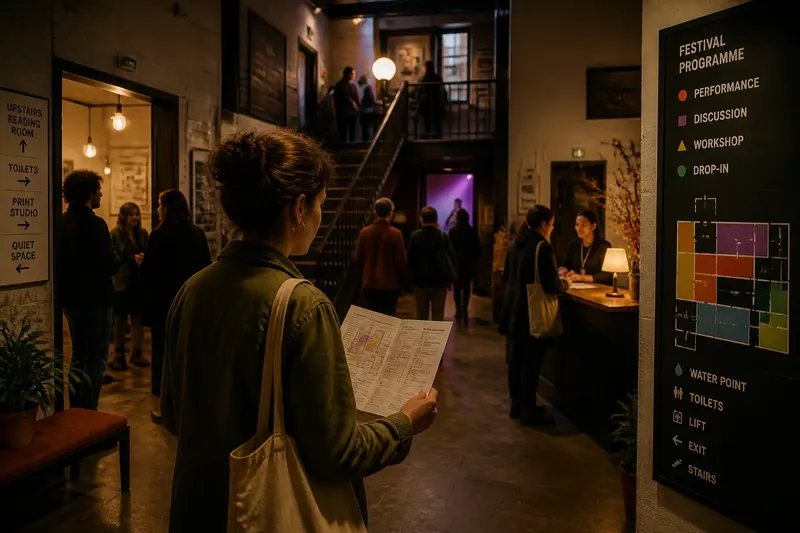
Where are the toilets, which door leads to the performance room, and where can you pause without blocking anyone? At a small indoor festival, those are often the first questions worth answering. A quick look around turns an unfamiliar building into a place you can move through with confidence.
Find the practical details before you arrive
Check the festival’s own information page or printed guide for the address, entrance arrangements, opening time, accessibility details, food and drink rules, and bag restrictions. A compact arts venue may have several rooms behind one entrance, while a converted hall may use separate doors for different activities. Confirming the arrival details helps you choose the right entrance instead of guessing at the threshold.
Look for room names as well as event titles, and note whether a session is a performance, discussion, workshop or open drop-in. The format can affect how you enter and leave: a screening may require a quiet entrance, while a drop-in activity may welcome visitors throughout. If the information is unclear, ask the organisers before you set off.
If you are meeting someone, choose a simple rendezvous point outside or just inside the entrance. A busy foyer can make phone messages hard to follow. Going alone? Notice a place where you could pause without standing in a doorway.
Use the programme to locate rooms and formats
Read the schedule with the venue in mind. Match the event you most want to attend to its room, then check whether that room is near the entrance, upstairs or down a corridor. A programme is useful here as a map legend: it helps you connect names on the page with doors in the building.
Notice overlaps, breaks and repeated sessions. If an event’s format is unfamiliar, look for notes about participation, late entry or materials. A workshop may involve making or discussing something; a reading or screening usually asks for attention. When the description does not answer a practical question, a steward can clarify it.
Make a quick orientation loop
After entering, step aside from the flow of people and identify the main landmarks: the reception or ticket desk, event rooms, toilets, seating, water point, exits and any quieter area. You do not need to memorise every corridor. Knowing a few clear landmarks makes it easier to find your way back if the foyer gets busy.
Follow signs and check with staff rather than guessing. A room called “Studio” might be a workshop space, and a corridor may lead to another event area rather than an exit. If there is more than one floor, find the stairs and lifts and confirm which routes are open to visitors. For access requirements, use the venue’s published guidance or ask staff about the route that works for you.
Watch how people are moving before joining a line. It may be for refreshments, entry or a session that has not yet begun. If you cannot tell, ask someone wearing a staff badge. Choose a temporary place to pause, such as a bench or marked seating area, and keep doorways, walkways and access seats clear.
- Check the entrance sign; if it names your event or ticket desk, use that door, but if it does not, ask a steward before joining a queue.
- Check the room name against the programme; if they match, go in, but if they do not, confirm the location with staff.
- Check whether a corridor is marked as an exit; if it is, keep it clear and use another route to pause, but if signs are unclear, ask before proceeding.
- Check whether the lift is marked for visitor use; if it is, use it for the route you need, but if access is unclear, speak with staff rather than assuming it is available.
- Check whether a queue has an event or refreshments sign; if it does, join only if that is where you intend to go, but if it has no clear sign, ask a steward first.
- Check whether a seat is marked for access or reserved; if it is, choose another place, but if no restriction is visible and you are unsure, ask before settling there.
How do you handle common first-visit questions?
Should you arrive early?
Arriving with time to spare can make it easier to find the correct room and settle before an event begins. If waiting in a crowd does not suit you, orient yourself first and return nearer the start.
What if two events overlap?
Check whether either event repeats or allows visitors to come and go. If both are one-off sessions, choose the room and format that best suit what you want from the visit.
Can you leave an event partway through?
It depends on the format and room. At a performance or screening, an aisle seat may make a quiet exit easier; at a workshop, ask the facilitator whether leaving mid-session will interrupt the activity.
What if you do not know anyone?
You can listen and move between rooms without introducing yourself. If you would like to talk, a simple question about whether a seat is free can open a conversation without requiring it to continue.
Choose a first event that fits the room
For a first session, consider the distance from the entrance, the room’s layout and how easy it is to settle. A clearly signed reading room may feel simpler to enter than a crowded workshop where materials are already spread across tables. Neither is better; choose the setting that feels manageable to you.
Imagine you arrive at a community arts hall and the programme lists a reading in the upstairs room and a printmaking session beside the foyer. You check the signs, confirm with a steward that the reading room is open, then find the lift and see that it is marked for visitors. You decide to attend the reading first because its room is clear and accessible to you; afterwards, you ask whether the printmaking session accepts late arrivals. If it does, you can visit; if not, you have still found the route to the reading without rushing between doors.
If a room feels full, noisy or unsuitable, step back into the foyer and ask staff about another option. A change of room is a practical choice, not a failure to follow the schedule. Take care not to interrupt a performance or enter a workshop while instructions are under way.
Make the venue comfortable to spend time in
Indoor festivals can gather sound and movement in a small space. If the foyer feels tiring, use a designated quiet area or permitted outdoor space, then decide where to go next. Earplugs may help with loud surroundings, but use them in a way that still lets you notice announcements and your surroundings.
Check whether refreshments are available and whether drinks are allowed in event rooms. Keep food and drink away from equipment, artwork and workshop materials unless organisers say otherwise. If you have dietary or access needs, consult the venue information or speak with staff; arrangements vary between festivals.
Look for a suitable seat before a session begins. A place near the back may make a quiet exit easier, but follow signs and ask before moving chairs in a room arranged for an activity. Take photographs only where permitted, and avoid including visitors who have not agreed to be photographed.
Remember the rooms that made the visit work
Before leaving, note the name of a room, performer or session you enjoyed, along with any venue detail that made moving around easier. Perhaps a side entrance was clearly marked, or a quiet seating area gave you space to regroup. Those specifics can help you decide what kind of event to seek next time.
A first visit to a small indoor festival is easier when you know how to reach the room you want, where to pause and whom to ask when a sign is unclear. Once those basics are settled, the venue itself becomes part of the experience: its doors, shared spaces and small gathering points show how the festival brings people together.