Before the Wristband: A Short History of Festival Tokens
Festival tokens have marked belonging, carried memories and helped organise gatherings. Learn how to read their different roles without mistaking possibility for history.
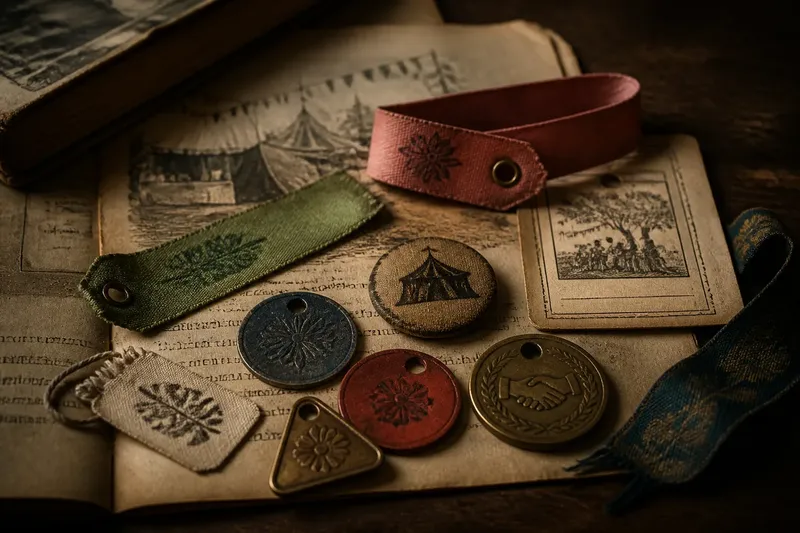
Festival tokens have marked belonging, carried memories and sometimes represented a claim to a service. If you are asking about the history of festival tokens before the wristband, the careful answer is that these objects have served different purposes in different gatherings; there is no single, documented line of descent from an ancient badge to a modern pass.
That distinction matters. The surviving object may suggest what it could do, but without a dated record or evidence of the custom around it, a proposed use remains a possibility rather than an established historical fact. A token is a little like a key: its shape offers clues, but only the lock and the people using it explain what it opens.
Festival token history has no single starting point
“Festival token” is a broad modern description, not the name of one stable object used everywhere across the past. A ribbon, printed card, badge or marked disc might identify a participant, preserve a memory or serve a practical purpose, depending on its setting.
For a short history, it is more responsible to distinguish those functions than to imply a universal chronology. A particular object can be placed in time only when its date, place and context are supported by evidence such as an inscription, an event programme, an archive record or a securely documented collection. Without that support, its material and appearance can prompt questions but cannot establish a date or custom.
Identifiers made participation visible
A badge, ribbon or marked card could act as an identifier where a gathering shared a convention about its meaning. Colour or a simple emblem might indicate a group, role or participation, but the object alone does not tell us which interpretation applies. That depends on evidence about who distributed it and how people used it.
Identification should not be confused with access control. A token could communicate affiliation without granting entry or proving permission to enter. Treating every old badge or ribbon as an early admission pass would turn a possible function into an unsupported historical claim.
Keepsakes carried the gathering into private memory
A printed card, programme or small emblem might be kept after an event as a reminder of a place, a meeting or a shared occasion. Its significance could come from a personal memory rather than from any official purpose. A fold, handwritten note or faded mark may offer clues to how an object was handled, but does not by itself reveal the owner’s story.
Materials can help explain an object’s possible use: paper is easy to print, while cloth can be worn or stored. Those qualities are not a timeline, however. They cannot show on their own when a token was made or how widespread its use was.
Shared symbols depended on local customs
An emblem could point to a place, craft, seasonal motif or community identity. Its meaning was not necessarily fixed: people might understand the same image differently, and a design could take on new associations as it was reused.
To interpret a symbol historically, look for evidence beyond the image itself. A dated programme, written description or record of the gathering may clarify who used it and what it represented. Without that context, the safest account describes what is visible and marks any explanation as tentative.
Some tokens may have represented a practical claim
A marked object might have represented a turn, entitlement or service within a local arrangement. But resemblance to a coin or voucher is not enough to establish that role: evidence would be needed about the rules governing its use and the exchange it represented.
This is where broad claims about festival tokens can become misleading. The possibility that tokens served transactions or services does not establish a particular historical example, date or system. For a specific object, contemporary wording, records or a well-documented chain of custody would be stronger evidence than shape alone.
What can a festival token tell us?
Were festival tokens always worn?
No. Some objects may have been worn, while others could have been carried, displayed or kept. The object’s intended use needs support from its context, not just its form.
Did a token always grant entry?
No. It might have indicated participation, represented a symbol or become a keepsake instead. An entry function should be claimed only when evidence connects the object to admission.
How can an old token be dated?
Look for an inscription, a named event, a dated programme or a reliable archival description. Material and style may help frame further questions, but they do not establish a date by themselves.
Can one object have several meanings?
Yes. An object could have been used as an identifier and later kept as a memento, for example. For a particular token, each proposed role still needs evidence from its own context.
Read an unfamiliar token from its evidence
Imagine you find a coloured ribbon tucked into an old festival programme. You note that the programme names an event but gives no explanation of the ribbon; a small hole at one end suggests it could have been attached to something. You compare the ribbon with any accompanying description or archive record, and find none. The careful result is that it may have been worn or attached, but its role and date remain unconfirmed; the programme provides a possible context, not proof of what the ribbon meant.
- Observe whether the object has a readable date or named event; if it does, compare that wording with a reliable record, and if it does not, leave its date unresolved.
- Observe whether an inscription names a group or role; if it does, describe that wording as evidence of an association, and if it does not, avoid assigning the object to a group.
- Observe whether a hole, pin or fastening is present; if it is, say the object could have been attached or worn, and if it is absent, do not infer that it was carried loose.
- Observe whether the token appears with a programme or other event material; if it does, treat that as a possible connection to investigate, and if it does not, do not claim a festival link without other evidence.
- Observe whether wording refers to entry, a service or an exchange; if it does, check for a record explaining its use, and if it does not, do not describe the token as currency or an admission pass.
- Observe whether a reliable catalogue or archive identifies the object’s source; if it does, report the attribution with its stated limits, and if it does not, describe only the object and its visible features.
The history of festival tokens is therefore best told through specific, supported objects rather than a single sweeping progression. A token may point towards belonging, memory, shared identity or practical exchange, but the evidence around it decides which account can be defended. When that evidence is missing, saying what remains unknown is part of an honest history.
For anyone examining one, preserve its accompanying papers and record where it was found before drawing conclusions. Those modest details may be more useful than the object’s apparent age or shape when its place in a gathering’s history is still uncertain.